|
Sylviculture ON THE CLIFTON ESTATE.
The Clifton Estate contains only about 511 acres of woodland,
the land being unsuitable for the growth of good timber. The soil is too light and friable, and
the locality is so badly wind-swept at times that for many years, bearing this in mind, the
woods and plantations were allowed to grow up with little thinning, because of the fear that
thinning would invite disaster in case of a heavy gale.
Now, however, more thinning is being done to admit sufficient
daylight to encourage the growth of undercover for game. Seven or eight men are employed in the
woods, and planting is being done, though more for the purpose of affording shelter for stock in
exposed pastures and for the improvement of the sporting than in pursuit of any policy of
economic arboriculture.
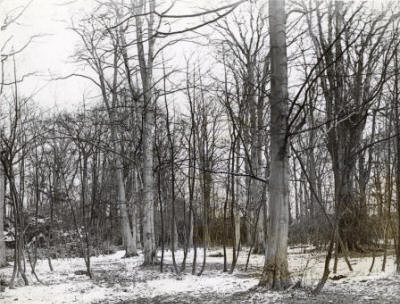
The woods, Lytham Hall, in February 1944.
Conifer saplings have been planted—grown in the Australian
pine, with a certain amount of spruce and larch in places where the soil is suitable. The
hard-woods most favoured are sycamore (which takes more kindly to the soil and climate than
anything else), English oak, beech, ash, silver birch, English and witch elm, and in low-lying
wet places willows and osiers. Latterly the pines have been grouped to give effect in the woods.
Such of the timber as is sold— approximately 2,000 feet per annum— fetches in rough from 9d. to
1s. per cubic foot; though the bulk of that felled is used for estate repairs, fencing, &c.,
and is worked up in the estate workshops at Lytham, where some thirty men are kept in constant
employment, including sawyers, carpenters, joiners, masons and painters, under the supervision
of a Clerk of Works, who also is responsible for the management of the estate
brick-yard.
The mansion, park and gardens, covering 72 acres, are at the
present let off to Mr. E. Hulton, of Manchester, on a short lease. The house, notwithstanding
its eastern aspect, is beautifully situated, with a view over a lovely lawn guarded by an avenue
of some of the finest trees in the whole Fylde district. All around are well-grown beech,
sycamore, elm, and oak trees, giants of a century's growth. To the north-west and west, the
house is sheltered by a belt of well- grown timber, and admission to the precincts is gained by
three inner lodges, in addition to the five outer lodges which surround the demesne. The park,
800 acres in extent, is protected by a well-grown belt of old timber some four or five miles in
circumference. Thus, of the 800 acres 180 are woodland, and after deducting the 72 acres let
with the mansion, there remains about 450 acres representing the area of the home farm. Of this,
270 acres is permanent pasture, 37 acres permanent meadow, and the remainder arable worked on
the six-course rotation.
Estate Magazine, August 1906 by F. H. Purchas
|
