|
WHERE DOES ALL THE BLOWN SAND COME
FROM?
Nuisance Which is Becoming a Commercial Asset.
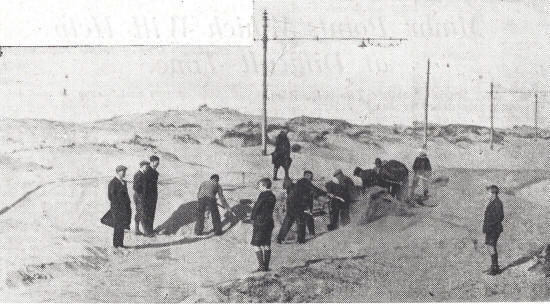
Portion of Clifton Drive North,
near Squires Gate, made impassable by blown sand.
-------------------------------------------------------------------------
NOT for many years has there been
so much blown sand in St. Annes as during the past winter. To householders and gardeners it is a
nuisance, and to people who use the streets the high wind, carrying dry sand from the shore into
the streets, is apt to be uncomfortable and oftentimes painful. No wonder that at such times
the promenade is deserted.
But to-day blown sand is not for
the Town Council the source of expense it once was To-day, thanks to the age of concrete, sand
has a commercial value. Many years ago, when high sandhills adjoined building areas, it was
common to see a board bearing the notice, “Sand may be removed free.’ To-day I believe the price
is somewhere round 4s. 6d. a load—and do your own carting. So that when blown sand piles up two
or three feet deep on North Drive there is no lack of people willing to clear it away for
nothing.
Sand Foundation Makes the Town
Healthy.
When we grumble about the blowing
sand we are apt to forget that it is sand which makes St. Annes so dry and healthy in winter.
Water percolates quickly through the sandy sub-soil. Similarly, I understand, it is because the
wind blows over so much salt- impregnated sand that we get what T. P. O'Connor called “the
champagne air of St. Annes.
Yet it can be a nuisance. The old
Urban District Council found it so. Its removal from the esplanade gardens and streets used to
cost hundreds of pounds a year, and a sand shield was built to stop it. During the past winter
it has come over this shield in dense clouds ten and twenty feet high, in something of the
nature of a Sahara Desert sandstorm.
For years this sand has been causing the foreshore to rise, and a fisherman native told me that in
the last 30 years the shore has risen 20 feet.
Where Does it Come From?
Where does all this sand come from
and will it ever stop coming? Is it nature's attempt to compensate for the erosion which takes
place on other coasts?
If one studies old maps and
navigation surveys there appear to have always been sandbanks in the Ribble estuary exposed at
low tide. The Horse Bank, between here and Southport, was tremendously high, and fishermen have
told me that when out in the channels at low tide if they wanted to see the shore they had to
climb the mast to look over the banks.
Sand and sand banks are never
constant. Wind, tides and even rains alter their formations, and the sand bank of this year may
be the channel of future years.
It has often been asked where all
the sand comes from, and perhaps the best explanation is contained in the appendices to the
minutes of evidence issued by the Royal Commission on Coast Erosion and Tidal Reclamation in
1907.
Expert's View.
In that very interesting volume,
Mr. T. Mellard Reade, a Fellow of the Geological Society and an Associate Member of the
Institution of Civil Engineers, wrote:‑
“If we turn to the chart of the
Irish Sea by Captain Beechy, republished in a reduced form in Beardmore's ' Manual of
Hydrology,' we may find a possible explanation.
“The tide of the Irish Sea,
entering by the South Channel, meets the previous tide entering from the North Channel,
creating a maximum rise of the tide at Fleetwood and Morecambe Bay. These tides bring with them
sand that has a tendency to accumulate on the South- West Lancashire coast, producing that
shallowing of the sea that exists. The accumulation of this deposit on the foreshore gives free
play to the winds which sift the grains of sand from the small quantity of mud with which they
are mixed."
That, of course, is a logical
explanation for the accumulation of sand on the foreshore at St. Annes. But many people are not
satisfied with that. They want to know exactly what sand is, and from whence it came before the
tide cast in on our shore.
What Sand Is.
Mr. Mellard Reade maintains that
it has its origin in the destruction of the pre-existing Triassic rocks, and intermediately,
Glacial Drifts and some of the Post-Glacial beds. As a rule, it consists of grains much rounded
by attrition.
Nature may be very wonderful, but
she is no conjurer, and for every ton of sand dumped by the tides and the wind on our shores
there must, at some place and at some time or other, have been a corresponding loss either on
the shores of this country or on the shores of another. In short, you cannot have accretion
unless you have erosion.
To a great extent this was borne
out by evidence given before the Royal Commission in 1907, and one witness, expressing concern
at the building of sea walls, told the Commissioners that unless erosion was allowed they could
not protect the coast. That, at first glance, may seem paradoxical; but it is none the less
true. This particular witness told the Commissioners that, if they put up sea walls, they would
ultimately be compelled to quarry from other parts to replenish the beach.
Gaining What Others Lose.
On the face of it, it seems that,
though sand can be an almost intolerable nuisance at times, it is, in reality, a boon and a
blessing. Briefly, we are gaining what other coasts are losing, and this accounts for the
constantly changing coast line.
As far as we in Lytham St. Annes
are concerned we are not so much interested in the accumulation of sand as the best methods of
preventing it from interfering with the essential services of the town as it has done in the
past. Sandstorms have cost Lytham St. Annes a pretty penny, one way or another, in recent years,
and so far we have not been able to effectively combat them.
Planting Starr Grass.
As I have already mentioned, the
sand shield did to some extent minimise the quantity of blown sand, but with the rise of the
sand banks and the shore much of that benefit has been lost. Then, again, the greatest
inconvenience, as is only to be expected, is caused along North Drive, where there is no
effective form of protection. Attempts have been made to stop the sand nuisance along this
stretch but with indifferent success. Perhaps the most effective method was the old one of
planting starr grass, and I have it on good authority that, when this was done by the Clifton
Estate, there was very little blown sand on the Drive.
Before long we may decide that old
methods are best and emulate the action of the Estate by profusely planting this grass. I for
one am convinced that by doing so we should lay the sand bogey once and for
all.
Lytham St.Annes Express,
1938
|
