Samuel Oglesby, photographer, 1823-1879.
|
|
London, England, 7th October 1833: At seven in the morning
two brothers, Samuel & Richard Oglesby opened the window of a house in
Paddington and the older brother, Richard, entered the building. Charles Lovegrove, a plumber
who lived in a nearby house, was just getting up for work. He saw the boys
and sent his apprentice for the police.
P.C. Peter Glynn went to the house and found Samuel stood at the window with a
bundle of goods, urging Richard to hurry up and pass him other items. They were both
arrested.
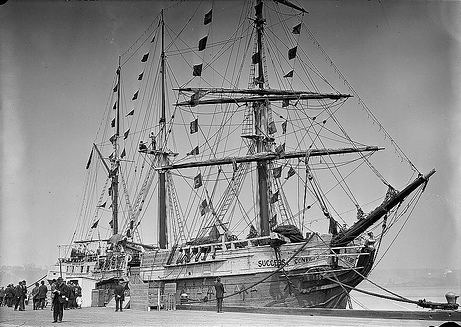 At the subsequent trial, they were charged with At the subsequent trial, they were charged with 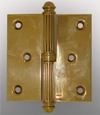 stealing a jacket, a waistcoat and 48 butt hinges; both were found
guilty. stealing a jacket, a waistcoat and 48 butt hinges; both were found
guilty.
In the eyes of the law, children were treated as adults. The sentence was
transportation to a prison colony for seven years.
A press report of the time adds that they were "two mere children"
- Richard was 12 years old and Samuel, just 10 years old.
There was a backlog of prisoners waiting to be transported so the brothers
spent two years in prison before they were placed on the convict ship John Barry which set
sail on the 7th September 1835 and arrived in Australia on 17th January 1836.
The separation from their mother, Hannah, must have been heart-wrenching and
whether they kept in contact is unknown. A letter would take four months to arrive and there is a
good chance that Hannah couldn't read or write.
|
Australia 1836-1850s
I haven't been able to research the life of the two brothers whilst
they were serving the seven year sentence. They may have been placed as servants with settlers or
sent to Point Peur, Tasmania though they probably learned a trade.
After seven years, the boys were given a Certificate of Freedom which takes
us to about 1843 and Samuel would have been 19 years old. He started following "the Art" of
photography from about 1844 and a few years later he was in business, taking photographic
portraits, and colouring them, at a time when photography was almost unheard of, especially in
Australia.
Perhaps after his seven year term he had become an artist's assistant
as some skill would be needed in order to colour the photographs by hand.
The first mention I have been able to find is in 1849 when Samuel
advertised his photographic studio in Adelaide, South Australia. The art (and science) of
photography was in its infancy at this time and photos were printed on copper plates which
had a highly polished silver surface and known as daguerreotypes.
|
We strongly recommend our fellow
colonists pay a visit to Mr Oglesby's Daguerreotype establishment at the rear of
the Clarendon Hotel, where the sight of the specimens which adorn his room –
coupled with the truly wonderful improvements that have been introduced by him into
the method of taking them will amply repay the trouble.
His portraits are exceedingly
beautiful, and are really first-rate likenesses, not having the cadaverous look so
common to these productions.’
Mercury & Sporting
Chronicle, Australia, 14th July 1849.
|
In another column Samuel placed an advertisement in which he identified
himself as ‘S. Oglesby’ of London, and said that his daguerreotype portraits were
being fixed by a new chemical process and would not fade. ‘Invalid ladies and gentlemen waited upon at their own residences. Terms
moderate. Hours from 10 till 5.’
A few months later he was advertising hand-coloured daguerreotypes, possibly the
first to be made in South Australia.
Between December 1849 and May 1850, Samuel toured various towns in Southern
Australia before returning to Adelaide. He was advertising in the Adelaide newspapers until at
least May 1851.
|
The Return to England in the early 1850s
Samuel left for England sometime in the early 1850s; his brother Richard stayed
in Australia and is listed in 1856 as living in Victoria. Samuel was now in his late 20s and his
mother, Hannah was still living in Marylebone, London, though she was now married to a grocer
and had five children by him. Samuel was reunited with his mother after a separation of 20
years and met his new family of half-brothers and half-sisters.
Setting up business as a photographer in England, he moved to Norfolk, taking
with him his half-sister, Ellen. They were to live together for the rest of their lives.
|
Norfolk and Suffolk, 1854-1856
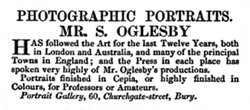 Samuel moved to Norwich where he spent two years as a photographer. He then
moved to Bury St.Edmunds and throughout 1856 he advertised in the local press. In the advert
pictured he states that he has 'followed the Art for the last twelve years
both in London and Australia.' Samuel moved to Norwich where he spent two years as a photographer. He then
moved to Bury St.Edmunds and throughout 1856 he advertised in the local press. In the advert
pictured he states that he has 'followed the Art for the last twelve years
both in London and Australia.'
He had a studio at 60, Church Street, Bury St.Edmunds. Click here for a recent picture; no.60 is the first low building on the
right. Here he moved away from Daguerreotypes (photos on glass) and started to print on paper.
|
Stockton-on-Tees, Durham, England, 1861
By 1859 Samuel was in Sunderland taking photographs of election candidates and
the 1861 Census, taken on 8th April, lists him as living with his half sister, Ellen, at
a photographic studio near Yarm Road and Trinity Schools. There is a carte de visite photo by
Oglesby of Sarah Backhouse, probably taken the Stockton & Darlington area
in the Durham County Council archives.
|
Preston, Lancashire, 1861-1866
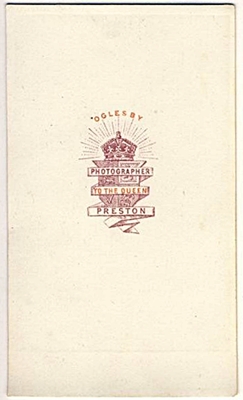 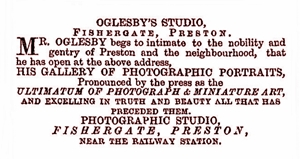 In October, 1861, Samuel opened a portrait studio in Fishergate, Preston, near
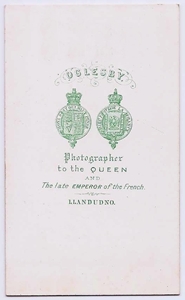
the railway station. On the back of many of his carte de visites is printed ‘Photographer to
the Queen and Emperor of the French.’ I can't find any evidence of
this though there is a portrait by him of Frances Anne Vane, Marchioness of Londonderry, in the National Gallery
archives. In October, 1861, Samuel opened a portrait studio in Fishergate, Preston, near
the railway station. On the back of many of his carte de visites is printed ‘Photographer to
the Queen and Emperor of the French.’ I can't find any evidence of
this though there is a portrait by him of Frances Anne Vane, Marchioness of Londonderry, in the National Gallery
archives.
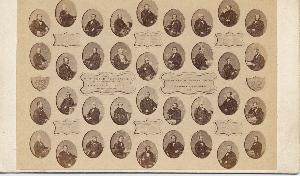
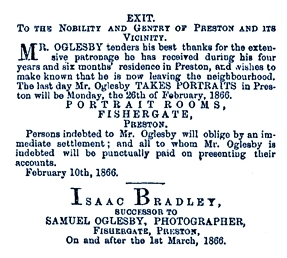
He remained in Preston for four and a half years and was best remembered
for taking portrait photographs of the members of the Corporation of Preston for the Preston Guild of 1862.
|
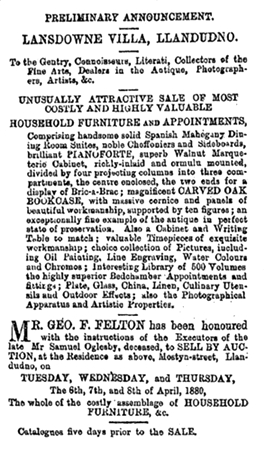 Llandudno, Wales, 1866-1879 Llandudno, Wales, 1866-1879
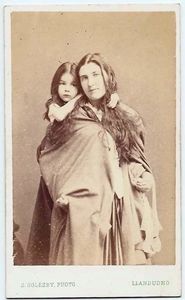 In 1866 Samuel moved to Llandudno with his half sister, Ellen, opening a portrait
at Landsdowne Villa, Mostyn street. This was to be his final move after a lifetime of
travelling. In 1866 Samuel moved to Llandudno with his half sister, Ellen, opening a portrait
at Landsdowne Villa, Mostyn street. This was to be his final move after a lifetime of
travelling.
Samuel's mother, Hannah, died in December 1878 and Samuel died the
following year on 1st September, aged 55 years. Richard, his brother, remained in Australia
and died (I think) in 1894 (to be confirmed).
After being brought up in the squalor of Dickensian London,
ten-year-old Samuel overcame the separation from his family and
endured two years in an overcrowded London prison.
As if that wasn't bad enough, he survived the four months voyage on a
convict ship and the seven year sentence in a Australia. At twelve years of age he
was one of the youngest criminals to be sent to a penal colony.
From humble beginnings, and a very bad start in life, he become one of
the first photographers in Australia. He succeeded in returning home to his
family and his photographic skills provided him with an income for
the rest of his life.
|
|
|
|

