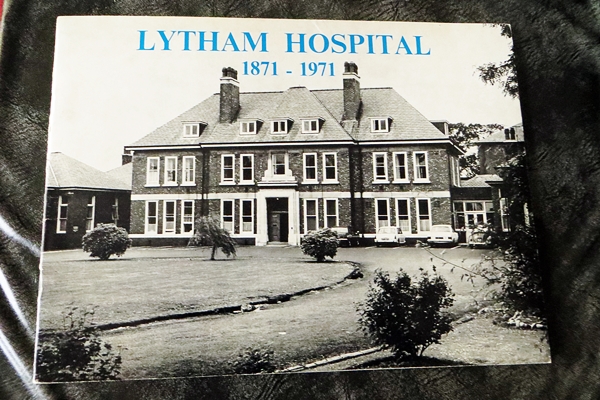
The opening of the Fisher Memorial Ward, Lytham
Hospital, 1901.
HONOURING- THE DEAD.
"LUKE FISHER MEMORIAL"
INTERESTING CEREMONY AT THE
HOSPITAL.
BEAUTIFUL TRIBUTES.
Another important epoch in the history of the Lytham Cottage Hospital was
reached on Saturday afternoon when the formal opening took place of the new
ward, built to perpetuate the memory of the late Dr. Fisher. Over 600
invitations were sent out, and there was a capital response. The Lytham
Volunteer Band had very becomingly offered their services, and from the lawn
they played a number of selections. Hard by the front entrance to the Hospital
a platform had been erected, and soon after three o'clock the proceedings were
opened.
The hymn “O God our help in ages past" was sung, with Mr. Lindley, A.R.C.O., at
the harmonium. and the Rev. Canon Hawkins then engaged in a suitable prayer as
follows :—" O Lord Jesu Christ, who, when on earth, didst heal all manner of
sickness and disease amongst Thy people, we pray Thee to let Thy blessing
rest on this new Ward of our Hospital. We thank Thee for the memory and example
of Thy servant Luke Fisher, whose name it bears. May all who exercise their art
of healing in this place and they who minister to the sick look up to Thee for
help and gain from Thee skill, tenderness, and faith. Make all who suffer here
submissive and patient to endure, whatever Thou shalt send, giving them a happy
issue out of all their afflictions. And grant that we to whom Thou hast
revealed Thy holy will may be enabled to fulfil the same and cheerfully
accomplish those things that Thou would'st have done, who livest and reingest
with the Father and the Holy Ghost, one God, world without end, amen."

Mr. Thos. Fair, J.P., C.C., then took the chair, and at once asked Lady
Drummond to open the new ward, in memory of their dear friend the late Dr.
Fisher. He suggested that the committee and guests should accompany Lady
Drummond through the buildings, and then presented her Ladyship with a
beautiful gold key with which to open the door.
An adjournment was then made to the east entrance, and after opening the door,
Lady Drummond formally declared the Ward open, passing in to survey the new
premises. Over the centre bed had been placed a large photograph of the late
Dr. Fisher, and immediately underneath a tablet of " Rose " metal,
mounted on a polished slab of oak, the inscription being as follows : —
" This Ward was erected by public subscription as a token of affectionate
regard and in memory of the late Luke Fisher, M.D., who for many years acted as
Honorary Medical Superintendent and Honorary Secretary of this Hospital. Opened
by Lady Drummond, September 21st, 1901." The tablet was executed by Cox, Sons,
Buckley &Co., Henrietta-street, Covent Garden, London, and the work was
greatly admired.
On returning to the platform, the following honoured Lady Drummond with
their support :- Mr. and Mrs. Thos. Fair, Mrs. Fisher, Revs. Canon Hawkins, J.
Gilbertson, T. H. Wright, and Dr. Burton, M.A., D.D., Councillor E. W. Mellor,
J.P., (Chairman of the Lytham Council), Councillor E. R. Lightwood, Mr. Wykeham
Clifton, Mr. A. W. Carrington, J.P., Dr. Eason, and others.
Amongst those present were Mr. Thos. Fair. ,J.P., Mr. A. W. Carrington,
J.P., Dr. Eason, Mr. E. W. Mellor, J.P., Mr. J. Needham, Mr. J. S. Fair, Dr.
Barlow, Mr. F. W. Broad bent and Mr. Edward Wilson, members of the committee,
with Dr. Cecil Fisher, secretary, and Mr. J. Lomax (assistant secretary), Mrs.
T. Fair, Mrs. and the Misses Carrington, Mrs. Eason, Mrs, Mellor, Mr. and Miss
Needham, Mrs. Barlow, Mrs. Wilson, Revs. Canon Hawkins, J. Gilbert- ,son, T. H.
Wright, W. H. .Johnson, B.A. (St. rAnne's), and Dr. Burton, B.A., D.D. (the new
Superintendent of the Wesleyan circuit), with Miss Threlfall, Mrs. Gilbertson,
Mrs. Wright. and Miss Burton, Mr. A. Wykeham Clifton, Mr., (Mrs., and Miss
Fullagar (St. Anne's), Councillor E. R. Lightwood, B.A., and Mrs. Lightwood,
Councillor and Mrs. Ainscough, Councillor Ashworth, Dr. Fernhead, Mrs. Fisher,
the Misses :Fisher (Lancaster, sisters of the late Dr. Fisher), Mrs. Outran.
the Misses Halket, Mr. T. A. Dean, Mr. Broadbent, Mrs. Talbot Fair, Mrs.
Pemberton, Mr. W. Kay, Mr, F. Harrison, Mr. Lindley, Mrs. and Miss Thompson
(St. Anne's), Mrs. and Miss Edleston, Miss Birley, Mr. and Mrs. Taylor, Miss
Foster, Miss Peel (matron of the Blackpool Hospital), and Miss Sellers (matron
of the Lytham Hospital).
Mr. Fair, the Chairman, then announced the receipt of letters and telegrams of
apology and congratulation. Canon Taylor had sent a kind letter in which he
said : "I have your letter about next Saturday's opening ceremonial. I wish I
could have attended. The event is of interest because of the object and the
name of him in whose honour the addition is made. I am so lame and incapable
that I must forego the pleasure. I wish you every success. Mrs. 0' Neill (a
daughter of the late Dr. Fisher) telegraphed: “Am with you all in spirit. All
wishes and hopes for a most successful day." Major Hincksman telegraphed from
Buxton : Sorry we cannot be with you to-day." And from Buntingford, Christine
Fisher had wired: " Wishing you every success to-day and always."

At this juncture a most charming little incident occurred. Confidently, but yet
with true maidenly modesty, little Miss Broadbent, a grand-daughter of the late
Dr. Fisher, made her way to the platform and presented Lady Drummond with a
magnificent bouquet of white roses, and lilies of the valley. Her ladyship
acknowledged the gift by kissing the bonny little donor. From the same hands
Mrs. Fair also received a bouquet of pink roses and lilies of the valley. The
bouquets were from Mrs. Maries, Clifton-square, and were of beautiful
design.
The Rev. Canon Hawkins proposed a vote of thanks to Lady Drummond. They all
most heartily welcomed Lady Drummond whenever she came to Lytham, and none
welcomed her more heartily than they who knew her best and who best remembered
her. (Hear, hear). He felt that there could be no more appropriate occasion on
which Lady Drummond could come before the people of Lytham than the occasion on
which they were met that afternoon, for they always thought of the Lytham
-Cottage Hospital as connected with the family of the Cliftons. (Hear, hear).
He had power to look back for one and thirty years at Lytham, and he recalled
well an afternoon in the year 1870 when he was asked to perform that very
office he had that afternoon performed of offering prayer on the occasion of
the first opening of the Lytham Cottage Hospital. It had been built as a gift
to the town from and by the munificence of the Clifton family, and the lady who
opened it on that occasion was the Lady Eleanor Cecily Clifton.
Since then, Lady Drummond had taken a deep interest in the
fortunes of the hospital, and he remembered well the old days when Mr. Henry
Clifton and Mrs. Clifton made almost daily visits to the Cottage Hospital,
cheering by their kindly presence the sufferers within its walls. Another
interest that Lady Drummond had on this occasion was that she was personally
attached to their dear friend, the late Dr. Luke Fisher, whose name this new
ward would bear. (Applause). He never heard anyone speak in More strong terms
of attachment than did the late Dr. Fisher of Lady Drummond, and he knew that
Lady Drummond reciprocated those feelings of friendship. He was quite sure that
everyone present was desirous of giving the heartiest possible thanks to Lady
Drummond for her presence and duties done that day. (Loud applause)
Councillor E. W. Mellor, J. P., seconded in a beautiful speech. He was one of
those who knew Dr. Fisher personally ; he was one of also, and perhaps many of
those present were, who had seen him in the sick room, who had noted how he
smoothed the pillow to the weary, aching head, noticed the quiet cheery words
that brought the smile to the enfeebled lips, and when-the sick chamber 'became
the chamber of death he had experienced their late friend's feelings of
tenderness and felt that one's own bleeding wounds became his, Such
recollections became living memories, and he therefore esteemed it a privilege
to be identified with, the ceremonial that afternoon, and he was sure that the
gracious act which Lady Drummond had just performed would live for ever in the
annals of the Lytham Cottage Hospital. If the late Dr. Fisher could have
suggested a memorial to himself, it would have been something that would have
tended to relieve suffering and distress, and this new ward was eminently
calculated to do that. (Applause). The new ward and the hospital could not be
maintained in its full efficiency and do the work Dr. Fisher would have liked
to see it do without a generous response from everybody all round. The fact
that they had only about 140 annual subscribers was something of which they
ought to be a little bit ashamed, considering the population of Lytham and St.
Anne's. All honour to those who did subscribe. He could not say that to those
who did not, and he hoped a word in season would enlarge the scope of the
hospital's efficiency. (Applause).
The resolution having been put and carried, Lady Drummond said :--" I am very
glad the Committee have asked me to open the Luke Fisher Ward of the Cottage
Hospital I should have been extremely sorry to miss so interesting an occasion,
for Dr. Fisher was a very good and kind friend to me and though everyone here
is his friend, no one can feel more gratefully affectionately towards him than
I do, as besides our long friendship, he, humanly speaking, saved my life. This
memorial is so very appropriate ; the Cottage Hospital was very near his heart,
and when I came to Lytham, 34 years ago this month; he was then already deeply
interested in the idea of it, and gave it his time and care most ungrudgingly,
as he did everything and everyone who wanted it. When I lived at Lytham and
went about a good deal, I heard on all sides of his kindness to the sick. I
remember one old woman who lived near Hallam telling me that when she was ill
with a very bad fever and her neighbours were afraid to come and nurse her Dr,
Fisher came every day added "He was a mother to me-" It is very pleasant to
think that when we also have gone the way of all men, Dr. Fisher's memory will
not be forgotten, and that the wing of the Cottage Hospital and the Luke Fisher
Ward will remain as a memorial of his useful life, and I hope, be of help and
comfort to many."

Mr. Needham proposed a vote of thanks to Mr. Fair for the important part he had
taken in the interesting proceedings they had witnessed. On behalf of the
members of the Hospital Committee, he also wished to say how very greatly
indebted they were to Mr. Fair for the assistance he had given in preparing for
that day, and especially did he deserve their thanks for having conveyed the
invitation from the Committee to Lady Drummond. 'the whole of the inhabitants
of Lytham and the district who had claims en the benefits and privileges of
that Institution, were greatly indebted to Mr. Fair, for he had been associated
with it ever since its inception in 1871, and during the whole of that time his
influence had been exerted and ins support given in furthering the human and
beneficent purposes for which the hospital was built and established thirty
years ago. The extension of the hospital would increase its usefulness, and it
would also increase its responsibilities and add to the labours of the medical
staff. But whist the medical staff would be quite willing to continue their
labours as they had done hitherto, and the patients would get the benefit of
their skill and advice, yet, on the other hand, the Committee would not be able
to carry on the duties of the hospital unless they found a greater amount of
support from the district. The institution was not endowed, and the amount of
-money received from invested funds was only four per cent of the expenditure.
What was wanted was a larger number of annual subscribers. (Hear, hear.) The
Committee had repeatedly to come before the public for help, but if they got
more regular subscribers they would be able to do without. They very cordially
acknowledged the generous liberality displayed to them of late, and the money
would be well spent. Those who had seen the new ward and the hospital as a
whole, would feel that the money had not been wasted. The new ward was a credit
to all concerned in its erection.
Dr. Eason, in seconding, said it seemed to him that the words uttered from that
platform were echoes of past Lytham, when they had their old friend Dr, Fisher
spoken of in such terms of endearment, and when they had with them Lady
Drummond, the Lady Bountiful of the old days —(hear, hear)—and Mr. Fair, who
for so many years had taken such a great interest in Lytham. In the old days,
these three individuals were absolutely necessary for the carrying on of every
social work in the district. When in any sort of difficulty they went to Mrs.
Clifton, and she referred them to Mr. Fair, and he used to tell them to get the
assistance of Dr. Fisher. When they had the three interested in any movement
they knew that success was assured. Now the only link between that time and the
present was Mr. Fair, and he was trying to get clear of his responsibilities,
but they called him from his rural retreat, and he did not seem to mind.
Mr. Fair was so invaluable to the hospital that they could not do without his
services. He hoped the t institution might long be upheld to carry out the
beneficent intentions of its founder.
The resolution having been carried with. applause.
Mr. Fair responded. He hoped that he might be able to work for the hospital
some years longer. (Hear, hear). As Canon Hawkins said, it was peculiarly
appropriate that they should have the presence of Lady Drummond, for
undoubtedly the inception of this Cottage Hospital rested with her and Dr.
Fisher in a great measure, not forgetting one who was there before him (the
speaker), his father. (Applause). The establishment of a hospital had been
talked about for some time by Dr. Fisher, but in 1869, whilst Mr. and Mrs.
Clifton were residing at Lytham Hall for the autumn, there was unfortunately a
slight outbreak of low fever in Lytham, and this brought the proposal to a
head.
Fortunately such timings didn't occur in the well-regulated Lytham of to-day.
The idea was at once taken up. Lady Drummond brought it before Colonel and Mrs.
Clifton, and Colonel Clifton, with that great generosity of heart almost
peculiar to himself, undertook to give a site and put up a building and also to
furnish it. The late Dr Holland, who had the care of some of the most important
buildings in Lancashire, gave them a sketch of that little building, and it was
put into the hands of Mr. Littler, the county architect, to prepare
plans. The foundation stone was laid by that lady, Cecily Clifton, on
September 2nd, 1870, and it was opened on the 3rd of August, 1871. Since that
time he (the speaker) had been on the committee, and had been more or less
connected with its work. He recalled the names of Mr. Greenwood and Mr.
Richards and others who had also ice closely and actively associated, and also
the name of Mrs. St. Clair, their first matron, who came from St. George's
Hospital. Miss Sellers would not be jealous if he said they might since have
matrons as good, but they never had a better than Mrs. St. Clair. Sometimes
they were told the hospital had not done as much good as it ought to have done.
Since the hospital was opened, 2,119 patients had passed through the hospital,
and more than half of these had been treated during the last ten years. The
highest number admitted in any one year was 158 in the year 1899. The hospital
now, as they saw it that day, 'would accommodate 25 patients.
The terms of the hospital were most reasonable, the very poor being
especially considered. The latter were admitted at 3s.6d. per week, or
sixpence a day, and the others, according to their means," at the moderate sum
of 12s.6d. If an outbreak of illness occurred among the domestic servants of a
large household, these could he boarded, lodged, and skilfully attended for
10s.6d. per-week.
As to, the necessity of greater help and larger funds he should not venture
upon any special pleading on that occasion, but he did beg of them that when
they were considering the disposal of surplus capital they would remember the
claims of the Cottage Hospital. He was glad to be able to announce &
perfectly voluntary subscription from Lady Drummond, who wished to be put down
as an annual subscriber for £5. (Hear, hear, and applause). Mr. Fair also
referred to a falling off in collections from the churches. In 1877 they
received £68 4s.5d. from this source. Last year, it was only £28 3s.11d., less
than 25 years ago, though the hospital was doing a much larger work.
The friends at St. Anne's had entirely forgotten that the hospital had any
claim upon them. He hoped that St. Anne's would remember that funds were very
touch needed, and that it would be borne irk mind that one-fifth of the
patients who passed through the hospital last year were from St. Anne's.
Mr. Fair announced that the following gifts had been made to the Luke Fisher
Ward :Five bedsteads by Mr. G. R. Bellamy ; two bedsteads, bedding, and four
pairs of blankets from Mr. Rhodes ; six pairs of blankets from Mrs. and Miss
Rhodes ; a clock and five quilts from Miss J. C. Halket; fireirons and
hearthrug, Mrs. Needham ; screen, Mrs. Thompson (Fairhaven): arm chair, Mrs.
Fisher; picture, Mrs. O'Neill and Mrs. Broadbent. Mr. Fair also thanked all the
friends who assisted at the bazaar last year and at the hospital fete this
year, and likewise others who had made gifts for the furnishing of the
hospital. It was also his duty to express their very deep gratitude to the
medical staff. (Hear, hear). Mr, Fair announced that the necessary documents
were being prepared for handing over the site and buildings by Mr. Clifton to
the town.
Perhaps the medical staff were ambitious for an operating theatre, but
practically the building was now finished. He had hoped they might have been
able to hand it over to the town perfectly free from debt. As far as the
building went he thought they were free, but there was often a skeleton
in the cupboard. The Urban Council have sent in a bill for street paving for
£150 odd. If they could get the Council to soften their hearts and forego that
amount, he did not think it likely they would be put into jail. The Council he
believed were advised that they could not allow this, but the allowance would
not be to an individual but to a building, which was being made over to the
public. Doctors differed, and so he supposed did lawyers. He was advised by an
eminent Town Clerk that the Urban Council could allow the amount with perfect
safety, and he felt every confidence that their friend Mr. Mellor, the Chairman
of the Council would do his best for them. He had in his hand one of the
hospital annual reports fur 1877, which contained the following par. :—"
Arrangements for opening a sanatorium for the reception of infectious cases,
have been made by the local Commissioners, and there can be no doubt whatever
that when fully completed it will confer a great boon on the town of Lytham,
and be very gratefully accepted by the public." if they could do that 25 years
ago, he hoped they might be able to make them the present allowance without
being surcharged. In conclusion he expressed his deep thanks to Lady Drummond.
She had come, at great inconvenience owing to a slight accident to her son.
The Chairman invited those present to partake of afternoon tea, and the
function closed, the band playing several selections whilst tea was being
served. The committee, had very generously provided this acceptable item out of
their own pocket, and Rymer's, confectioners, of Clifton-street had been
entrusted with the task. That they did their work satisfactorily may be
gathered from the fact that Lady Drummond and many others expressed the
appreciation that all no doubt, felt. After the guests had departed, the
patients who had been permitted to watch the ceremony were served with tea, and
a most enjoyable party was then concluded.
It should be stated that Mr. Bellamy, the indefatigable hon. treasurer to the
Hospital, was all the South of England on Saturday, and was therefore unable to
be present.
|