SANDHILLS UNDER WATER,
Tramway Manager's Son Neck-Deep in Icy
Water—Narrow Escape in Bedroom
Wreck—'Bus Warned in Time.
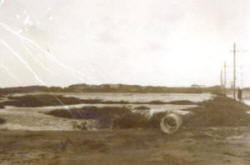 The gale reached its highest velocity at St. Annes shortly after midnight, when,
for the first time in the town's history, the tide broke through the sandhills on North Drive
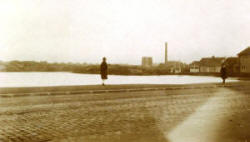
and flooded the road to a depth of six feet. Early on Saturday morning the stretch of
sandhills between Kensington and St. Leonard's-roads presented he appearance of a vast lake.
Seaweed was piled high against the walls of the houses on the opposite side of the road, and
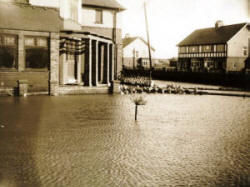
two sunken gardens were flooded to the height of the walls. The front wall of the Ormerod
Convalescent Home was levelled to the ground, and water stood to the level of the ground-floor
windows. It is estimated that the sandhills in this vicinity were 16 feet under water at the
height of the storm. The gale reached its highest velocity at St. Annes shortly after midnight, when,
for the first time in the town's history, the tide broke through the sandhills on North Drive
and flooded the road to a depth of six feet. Early on Saturday morning the stretch of
sandhills between Kensington and St. Leonard's-roads presented he appearance of a vast lake.
Seaweed was piled high against the walls of the houses on the opposite side of the road, and
two sunken gardens were flooded to the height of the walls. The front wall of the Ormerod
Convalescent Home was levelled to the ground, and water stood to the level of the ground-floor
windows. It is estimated that the sandhills in this vicinity were 16 feet under water at the
height of the storm.
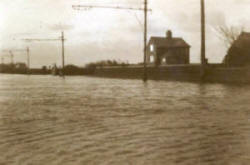 The lights failed at the Lytham St. Annes Corporation's Tramways Depot at
Squires Gate, and Mr. H. W. Laing (the Tramways Manager) sent a Corporation 'bus, in charge of
his son, Mr. Kenneth Laing, and J. Riley, one of the drivers, to the sub-station in St.
Thomas's-road, St. Annes. Near Kensington-road, the 'bus, travelling in pitch darkness, ran
into a huge lake of water, which swept high over the wheels. The 'bus was marooned for the
rest of the night, and when Mr. Kenneth Laing, who is a tall man, scrambled out, the icy water
reached his neck, and it was only with the utmost difficulty that he returned to the
Depot. The lights failed at the Lytham St. Annes Corporation's Tramways Depot at
Squires Gate, and Mr. H. W. Laing (the Tramways Manager) sent a Corporation 'bus, in charge of
his son, Mr. Kenneth Laing, and J. Riley, one of the drivers, to the sub-station in St.
Thomas's-road, St. Annes. Near Kensington-road, the 'bus, travelling in pitch darkness, ran
into a huge lake of water, which swept high over the wheels. The 'bus was marooned for the
rest of the night, and when Mr. Kenneth Laing, who is a tall man, scrambled out, the icy water
reached his neck, and it was only with the utmost difficulty that he returned to the
Depot.
All the covered double-decker cars were withdrawn from the Lytham St. Annes tram
service during the early hours of the gale, and passengers travelling from Blackpool to Lytham wad
St. Annes were transferred to the Corporation 'buses. It was not possible to resume the tramway
service between Squires Gate and Lytham until eleven o'clock on Saturday morning. Until. that time
'buses were pressed into service.
 Mr. and Mrs. John Marsden and their little daughter, who reside at 76,
Clifton-street (now Curzon Road), St. Annes, had a
miraculous escape from serious injury. At 12-20 in the morning, immediately after the little
girl had joined her mother and father in the back bedroom, the window-frame was blown clean
out of the wall into the room. In its fall it upset a dressing-table, which was just below the
window, and crashed into a wardrobe against the opposite wall. The bed was a few feet to the
side of the window, and, except for a heavy fall of plaster which covered the counter-pane,
the three occupants were none the worse for their terrifying experience. Mr. and Mrs. John Marsden and their little daughter, who reside at 76,
Clifton-street (now Curzon Road), St. Annes, had a
miraculous escape from serious injury. At 12-20 in the morning, immediately after the little
girl had joined her mother and father in the back bedroom, the window-frame was blown clean
out of the wall into the room. In its fall it upset a dressing-table, which was just below the
window, and crashed into a wardrobe against the opposite wall. The bed was a few feet to the
side of the window, and, except for a heavy fall of plaster which covered the counter-pane,
the three occupants were none the worse for their terrifying experience.
Early on Saturday morning, the bedroom presented a scene of chaos. The
dressing-table was piled on the wardrobe, the window-pane lay slanting on its side, and the bed
stood under a canopy of plaster.
The plate-glass windows of four shops in the centre of St. Annes were blown in,
and there was extensive damage to property by the fall of chimney stacks. The side of a shop at the
corner of Alexandra-road and Clifton-street (Curzon Road) was
torn away, and a big poultry house on a market garden at the far end of Church-road was wrecked,
although only one hen was killed. The big flag-staff at the Royal Lytham and St. Annes Golf Club
was broken in two like a twig.
A night watchman on duty at the sewerage scheme near the Blackpool Old Road
probably averted a disaster when he stopped a Corporation omnibus from Lytham and warned the
driver that a huge tree was blocking the track little farther up the road.
|
